An AI that learns who you are
You didn't choose this profession to fill in boxes. You chose it for your clients — their progress, their setbacks, everything a cold report never says. And yet every tool handed to you asks the same thing: set aside your own way of working, learn its fields, its order, its logic.
This isn't a tooling problem. It's a logic problem. Professional orders publish guides to help you structure your evolving notes — a sign, in itself, that documentation has taken up room clinical time no longer has. We chose to reverse that logic instead of adding another layer to it.
"Notes? Stats? When do I do that?" — Wendy Doodat
It knows exactly when: right after, while it's still fresh.
The thesis, plainly
We didn't build another form to fill in. We built an AI that learns who you are — how you write, how your order structures a note, the pace you work at — and adjusts to you. Not the other way around.
Two ways to build a documentation tool
What generic tools ask of you
A template designed elsewhere, given a Quebec-facing coat of paint. You learn its fields. You translate your practice into its structure. And every correction you make disappears at the next draft — you start over, every time, from zero.
What Wendy Doodat builds
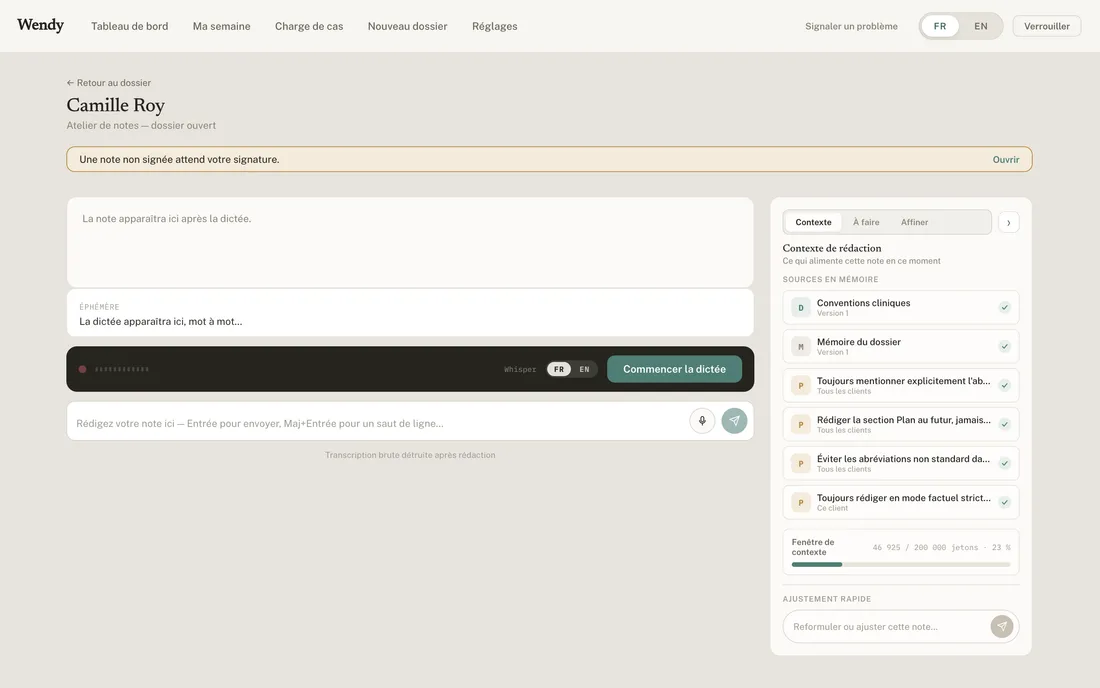
A note drafted in your professional order's own structure — not a generic structure repainted for the occasion. Every correction you make stays: the next draft sounds a little more like you than the last one, and keeps sounding more like you over time.
Two mechanisms built to do that: templates mapped to your professional order, and a learned-preference loop that retains every correction you make.
What it means right after
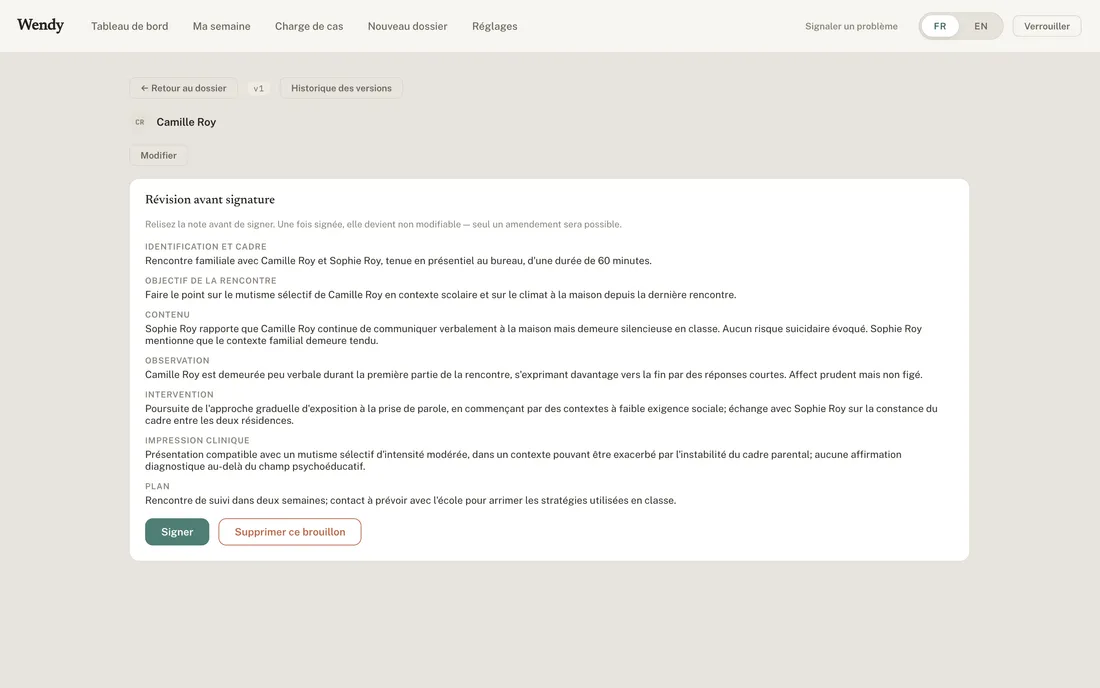
You dictate right after the encounter — in the minutes that follow, while it's still fresh. Not tonight. Not on the weekend. The draft is ready in seconds, before your next appointment. And it sounds like you: your vocabulary, the structure your professional order expects, the nuances you've already taught it.
Nothing is final without you. You review, correct, and sign — the last line is always yours.
And if you run a team?
This page speaks first to the person writing the note. But we know you're reading it too — you who answer for a team, not just a workstation. The same logic holds at that scale: consistent documentation, without standardizing — or flattening — each professional's clinical judgment.
What we believe
- "Wendy Doodat adapts to you. Not the other way around."
- "A generic template asks you to change your practice. Wendy Doodat learns yours."
- "Every correction you make, Wendy Doodat remembers. The next draft sounds even more like you."
- "Your clients aren't checkboxes. Your notes shouldn't be either."
- "Built and tested so your client's identity never leaves your workstation in plain text. Your way of writing never leaves your file."