One place for the whole documentation workflow — built for Quebec psychoeducation.
Dictation, drafting, review, case file, caseload: Wendy Doodat covers the whole path of a note, from the first word to signature.
"Notes? Stats? When do I do that?" — Wendy Doodat
It knows exactly when: right after, while it's fresh.
Wendy Doodat isn't a text editor with AI bolted on. It's a complete flow — from dictating right after the encounter to a signed case file — built from the ground up around how a psychoeducator actually works.
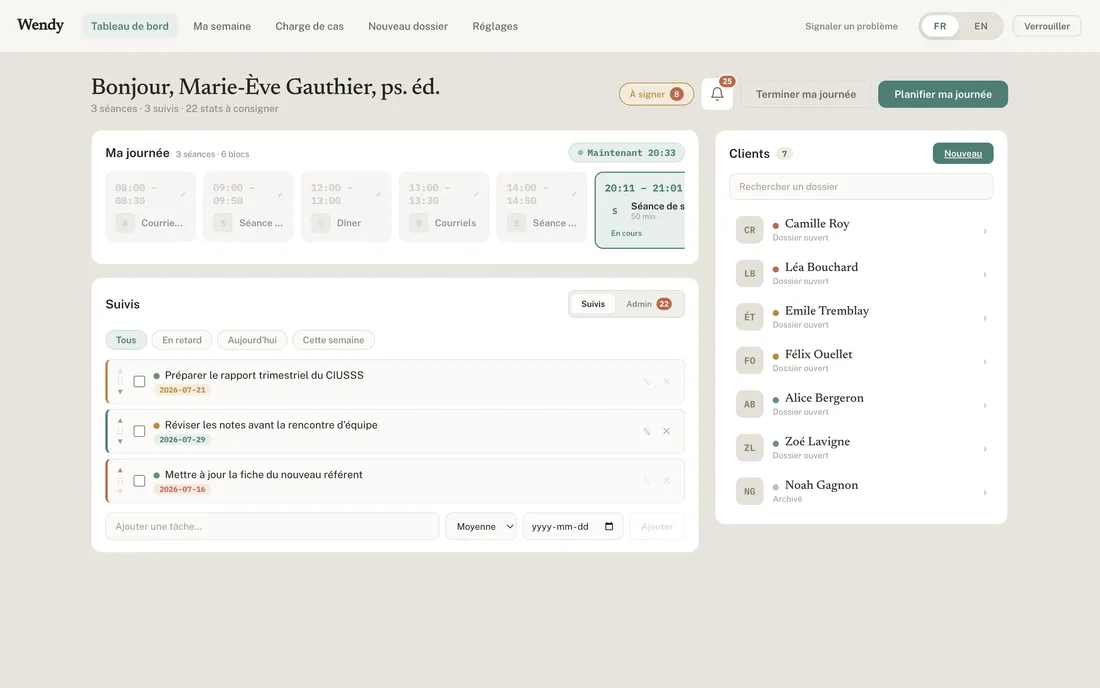
Organization aside: every block below is a drafting accelerant built to apply across a whole team — without replacing the system your staff already use.
Dictate the note in the minutes after the encounter.
Speak; Wendy Doodat transcribes and drafts a note structured to your professional order's conventions. The draft is ready moments later, dictated right after — not that evening, alone, in front of a screen.
In our internal testing, the path from dictation to a full draft took about 15.5 seconds. That's a test figure, not a guaranteed time for every note.
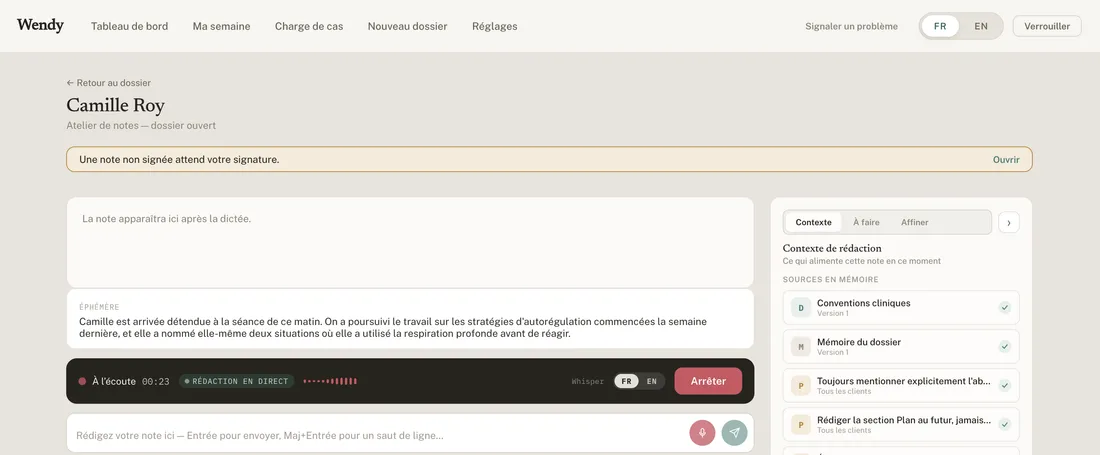
Organization aside: a drafting accelerant across a whole caseload, without replacing the case-file system your team already uses.
You review, you correct, you sign.
Nothing is final until you say so. The AI drafts; you stay the final word — exactly as your professional order requires.
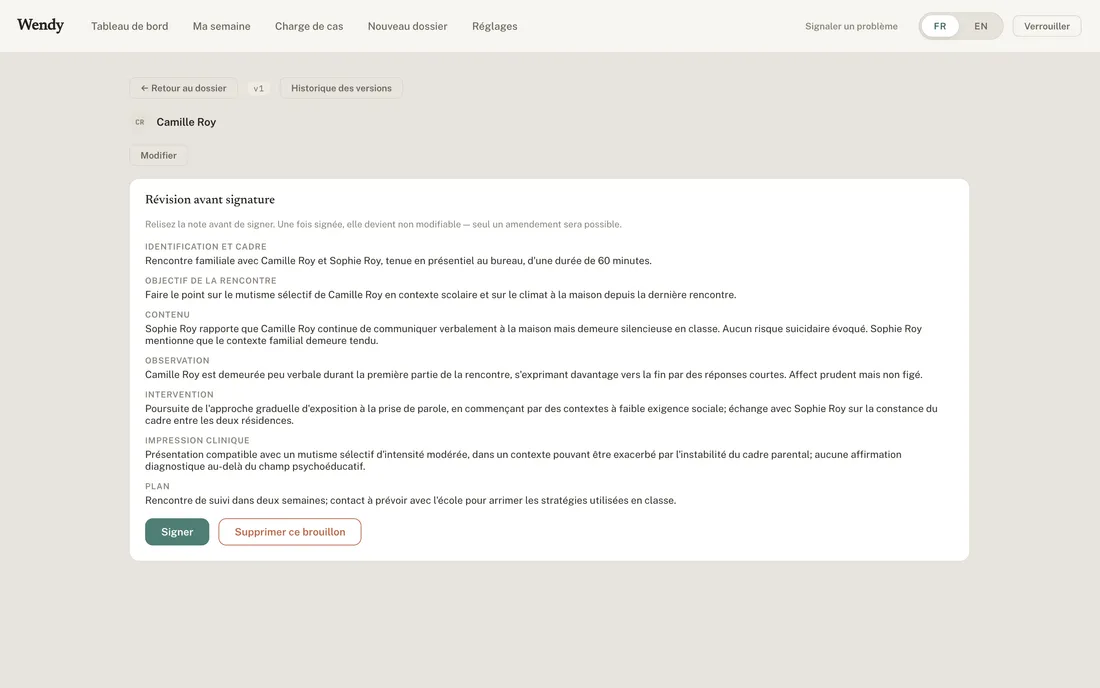
Organization aside: the AI is never autonomous. Clinical accountability stays fully with the practitioner, note by note — the direct answer to an audit's central question: who approved what, and when.
Every correction you make, Wendy Doodat remembers.
Propose a correction once; it carries forward into every future draft. The more you use it, the more drafts sound like you — not a generic template.
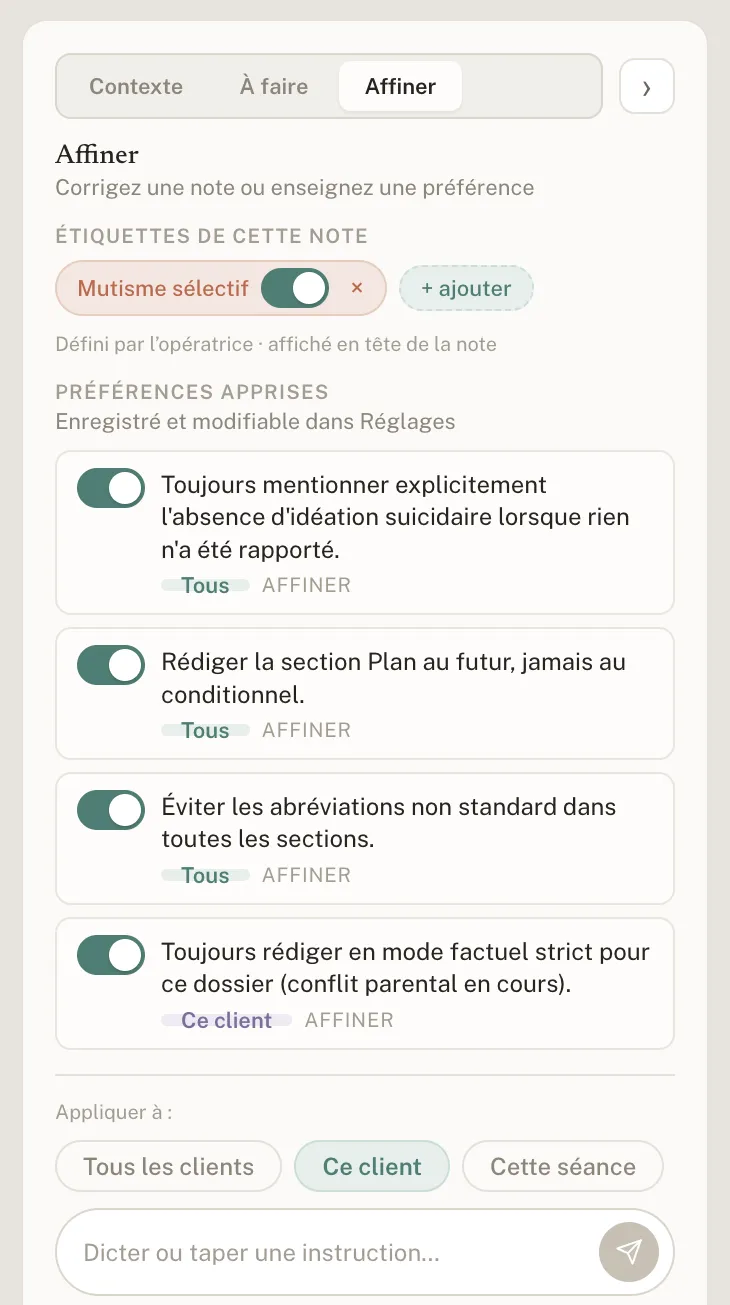
Organization aside: a mechanic that compounds with tenure: what a team has taught it over months isn't something a new tool can replicate overnight — an asset that stays with the team, not the vendor.
The AI works from your documents. Never a generic model.
Your conventions, your templates, and your learned preferences stay in memory and feed every draft. That's what lets a draft sound like you from the first line — not after several rounds of edits.
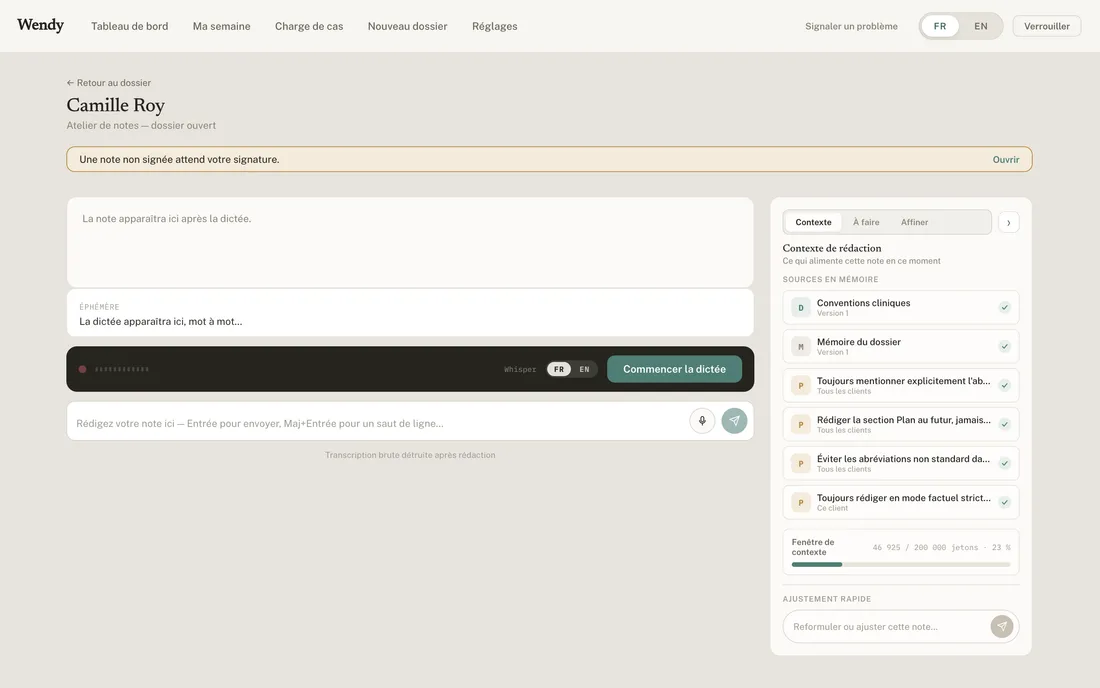
Organization aside: the same logic that personalizes each practitioner individually, without ever standardizing — or flattening — their clinical judgment.
A complete clinical record. Nothing is ever rewritten.
Every correction creates a new version; nothing is deleted or overwritten. The full history stays visible, note by note.
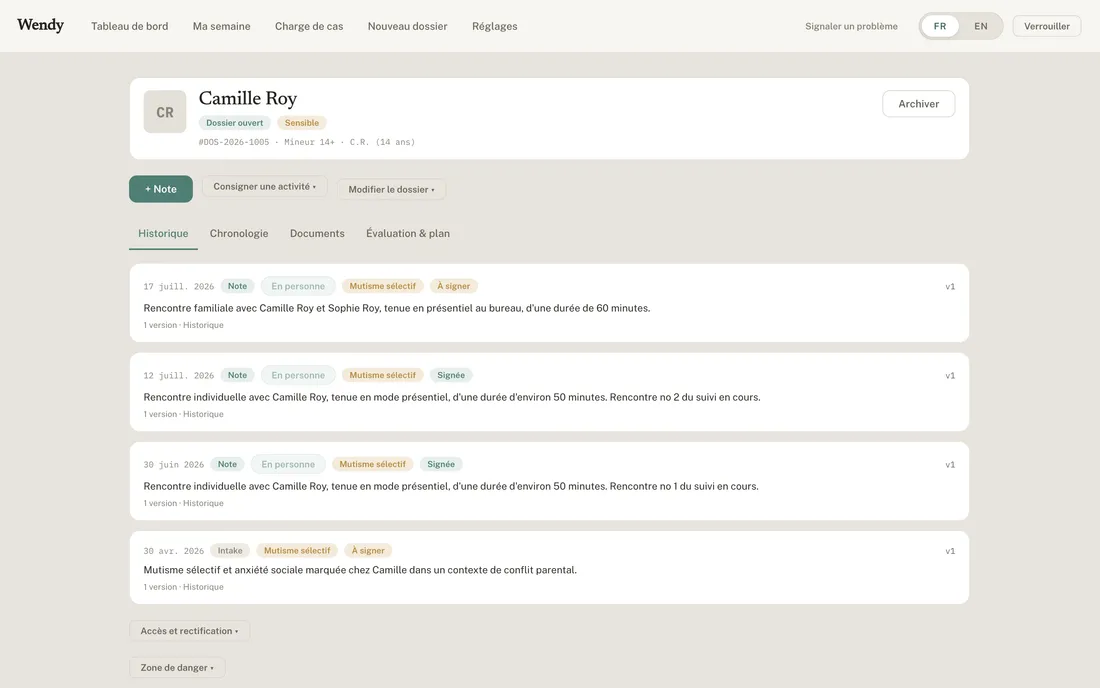
Organization aside: an append-only audit log automatically records every create, read, sign, rectify, and export. A concrete answer to an audit question — not just a policy document.
Your week and your caseload, at a glance.
The Week view organizes your sessions, admin time, and breaks across the full work week. The Caseload view groups your entire client list, searchable and sortable.
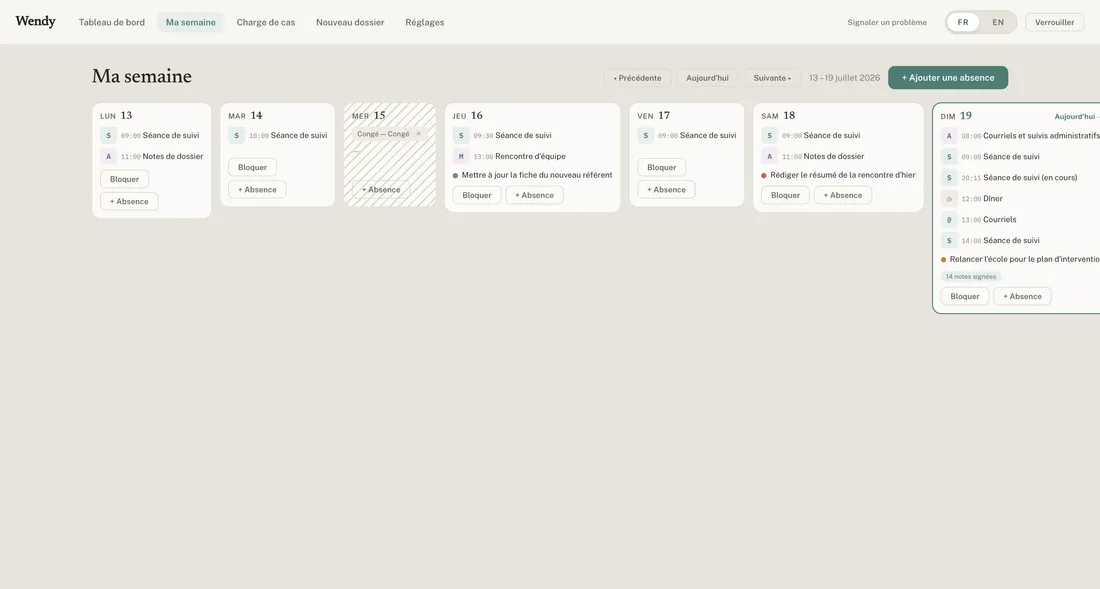
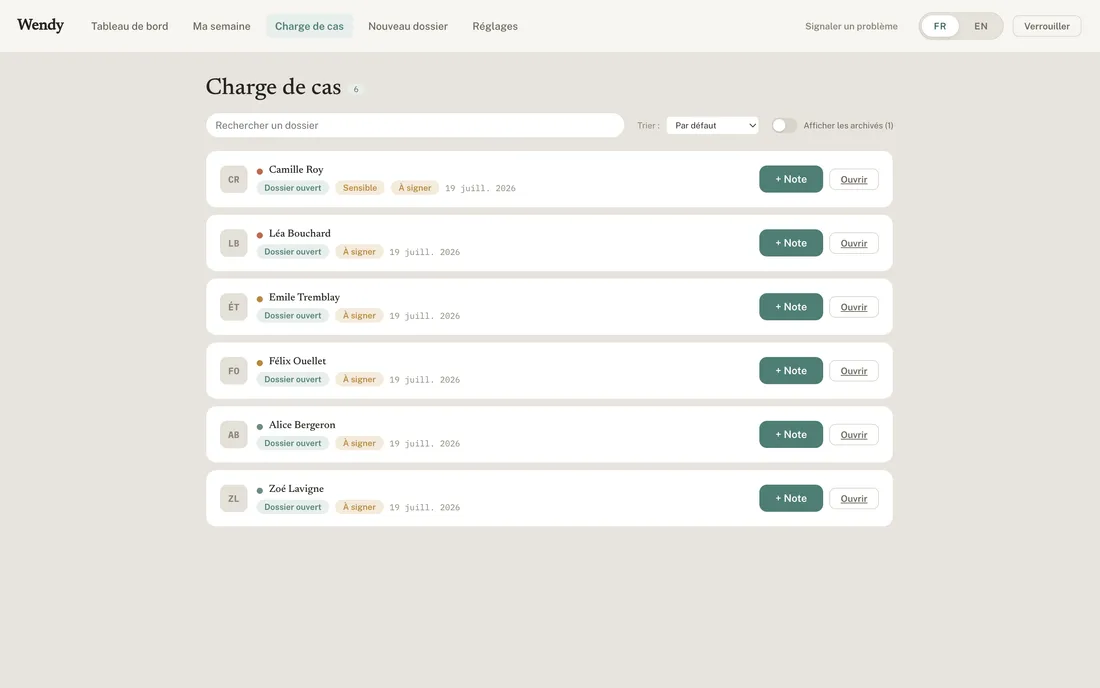
Organization aside: the same caseload view gives a supervisor a full-team read, not just one practitioner at a time.
Templates mapped to OPPQ conventions — not a generic form.
Wendy Doodat drafts to the OPPQ's seven-section structure. The mechanism is built to extend to other professional orders; today, only OPPQ is configured.
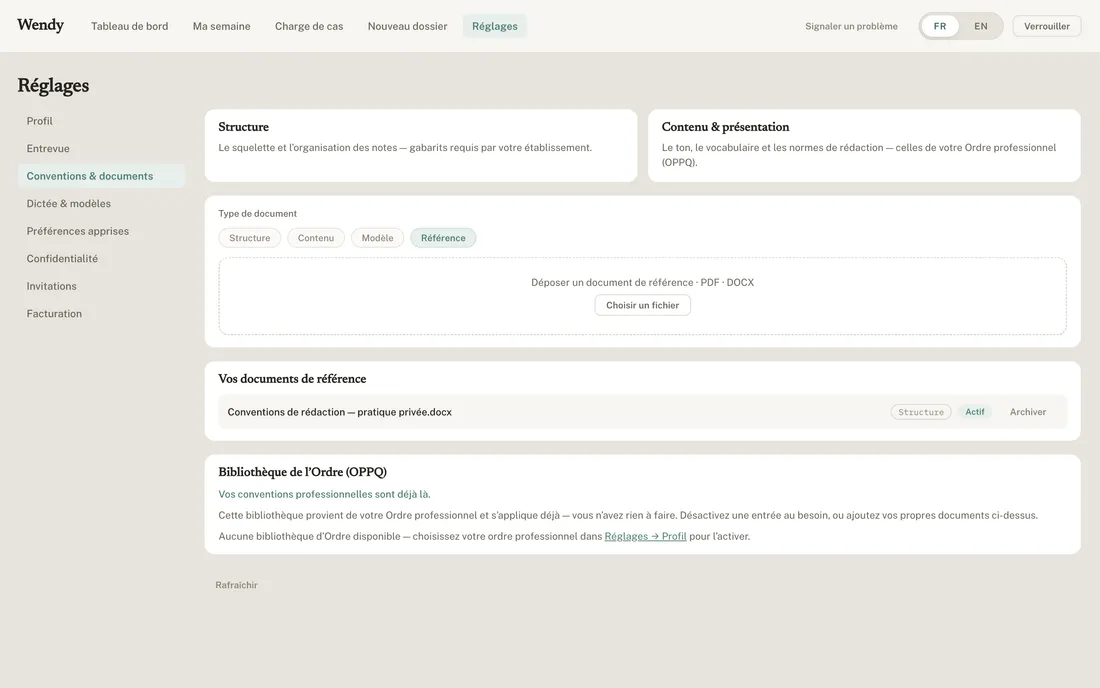
Organization aside: a foundation built to extend to other regulated professions within the same organization — relevant to any organization spanning more than one professional order. The actual configuration for a second order doesn't exist yet (direction, see "What's next" below).
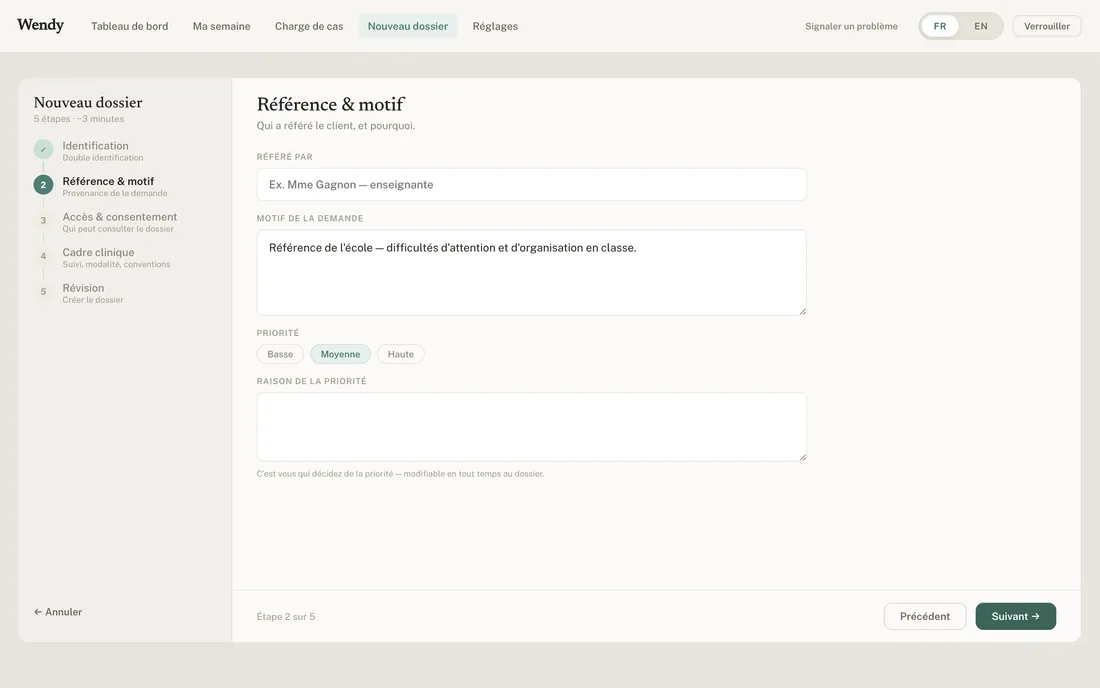
Starting a new case is guided — not a blank page.
The intake wizard moves step by step, with a clear progress state on every section. Nothing to guess when opening a new case.
Capture a note from your phone — even offline.
The app works offline for capture, auto-locks, and picks back up with full parity on desktop as soon as you return to the note.
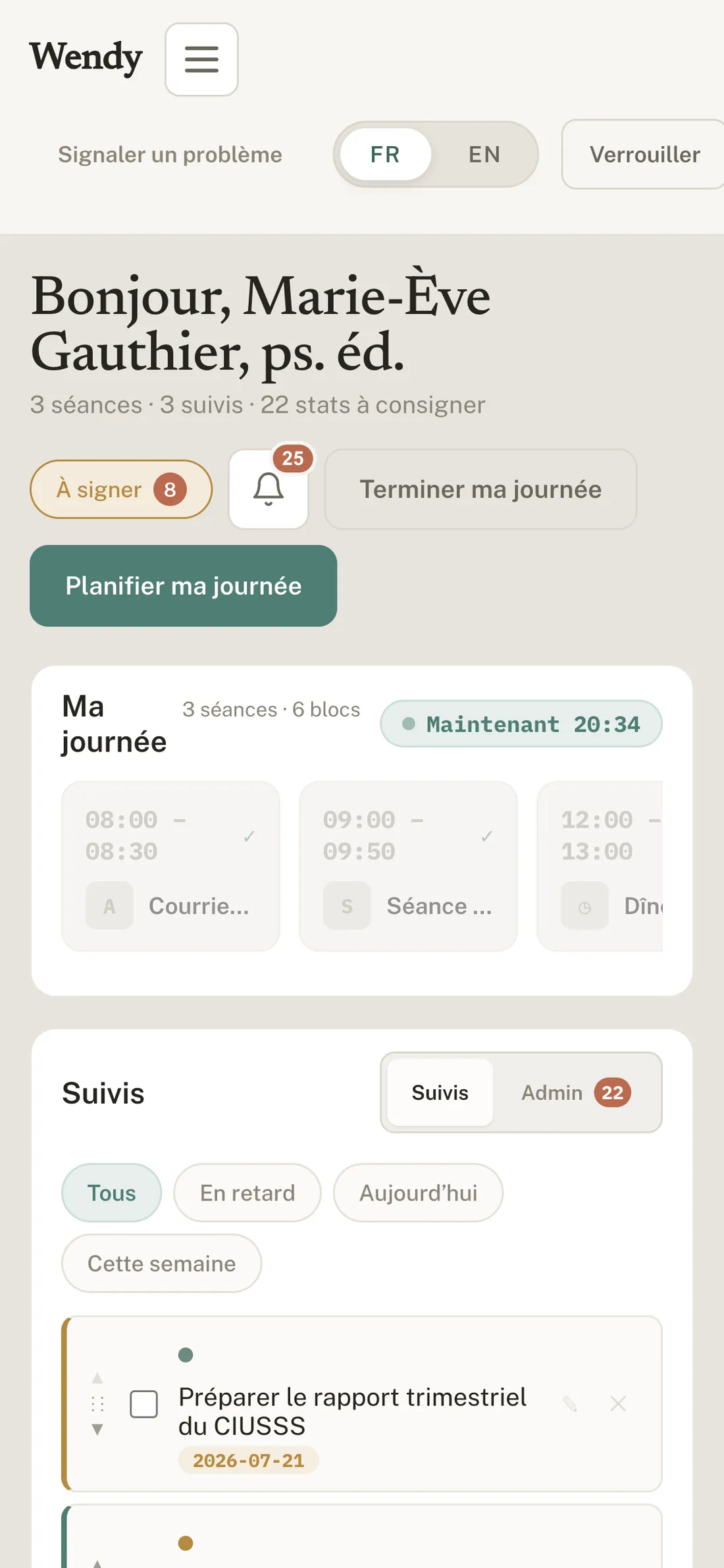
Organization aside: real support for staff on the move — home visits, multi-site schools, field work.
Architecture and confidentiality
Built and tested so your clients' identities never leave your workstation in plain text.
Names, dates of birth, case numbers, and other identifying fields are encrypted directly on your device, before anything leaves your workstation. Built and tested so the server never receives an identity in the clear — and a server-side check blocks any attempt before any AI spend even occurs. Even the internal support and admin tools are designed so they cannot read who a note is about.
On data residency: your primary clinical records reside on a server located in Canada (Toronto) as of July 17, 2026.
On certification: formal privacy certification is work in progress — we document exactly where that stands rather than display a badge.
The path of a client's name
Consent that's dated, explicit, and revocable at any time.
Consent to AI use is dated and explicit. If revoked, no new AI generation is produced — dictation still transcribes, and the note continues manually.
What's next
Direction we're exploringWhat follows is direction we're exploring — not a shipped feature, not an announced date.
Extend the template mechanism to professional orders beyond OPPQ. (The mechanism itself is already built; what remains is configuration work for a second order.)
Deepen the learned-preference loop further.
A consented, practitioner-shareable proof mechanism — for example, a personal time-recovered metric a practitioner can opt to share, or not.