An AI rollout that forces every practitioner to change their practice to fit a generic tool isn't an efficiency gain — it's a new risk.
Uneven adoption, diluted clinical conventions, a documentation trail that doesn't hold up under audit. Wendy Doodat inverts that relationship: the architecture is built to capture the conventions specific to each professional order and adapt to how each practitioner actually works, without a client identity ever leaving the workstation in plain text. The result for an organization: consistent, defensible documentation without standardizing — or flattening — each professional's clinical judgment. An architecture built to survive scrutiny, not just win a demo.
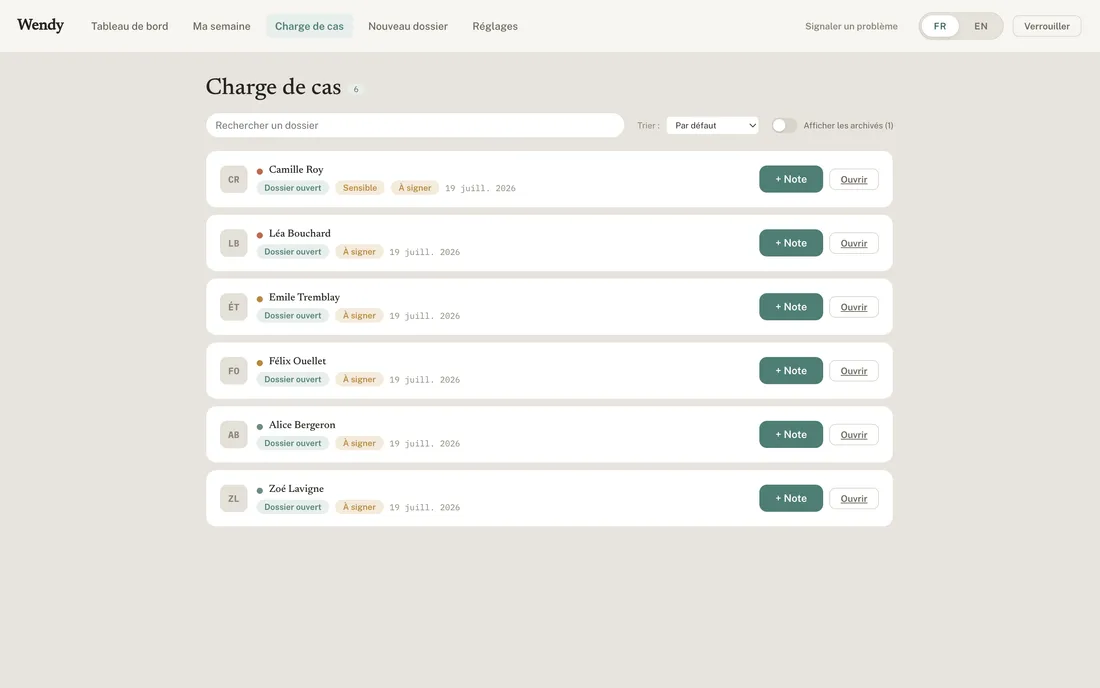
Designed to give back clinical time — not to sell technology.
Wendy Doodat is designed so your psychoeducators document less and spend more time with your clients. How much time, exactly? We don't yet have customer data to put a number on it — the proof surface is honestly empty at this stage (no testimonial, no real-usage statistic exists yet). What we can say: it's a hypothesis, on the order of a few hours per week per practitioner, that a pilot with your team would let you measure with your own data — not a promise made in advance.
(No image here: an honest placeholder — to be measured with your team, not yet a published customer result.)
Built for Quebec's rules — and we'll show you exactly where that stands.
French-first by default, not added on afterward. Client identities are designed to never reach an outside AI vendor in the clear: encryption on the device itself, with a server-side gate that blocks any attempt before it's sent. Primary clinical records are hosted on Canadian soil (Toronto), as of a dated cutover. Formal privacy certification is substantial, documented work in progress — and not yet obtained. We show you precisely where that work stands rather than asserting it in one line.
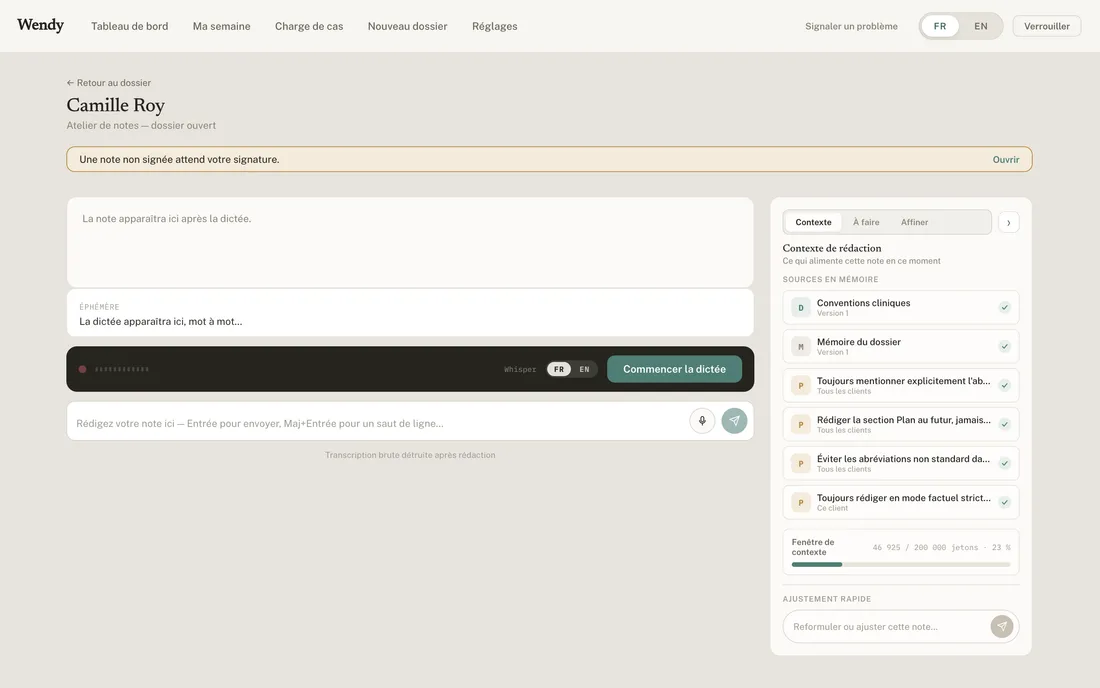
The path of a client's name
AI drafts. The clinician decides.
Every note is drafted by the AI, then reviewed, corrected, and signed by the psychoeducator — never the reverse. Every create, read, sign, rectify, and export writes a row to an audit trail that is never erased. This is an architecture the product satisfies by construction, not a policy stated on paper.
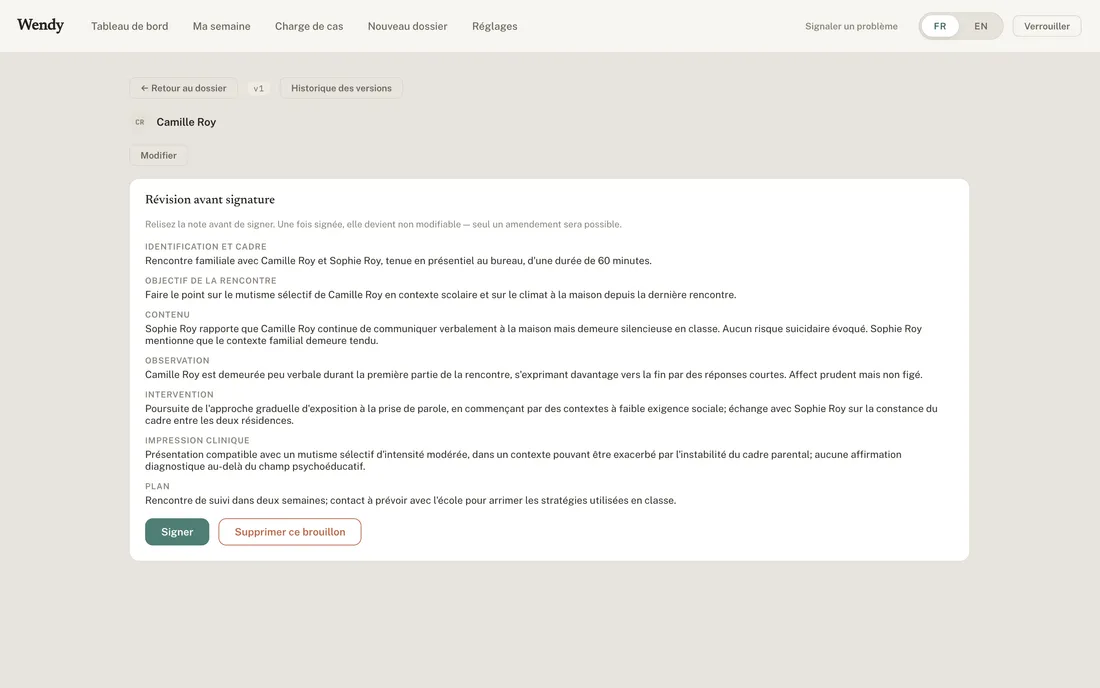
Works alongside your tools. Not another system to learn — a complement to what you already have.
Wendy Doodat does not replace your electronic health record. PDF export is always available: your notes are never held hostage. Deeper integrations with your existing systems are a question we hear — we don't have an integration to point to yet.
Consistent documentation — without standardizing clinical judgment.
The mechanism that maps notes to a professional order's conventions is built to extend beyond a single order. Today, it's configured for OPPQ. Each professional keeps their own way of working; the structure stays aligned to their order's conventions.
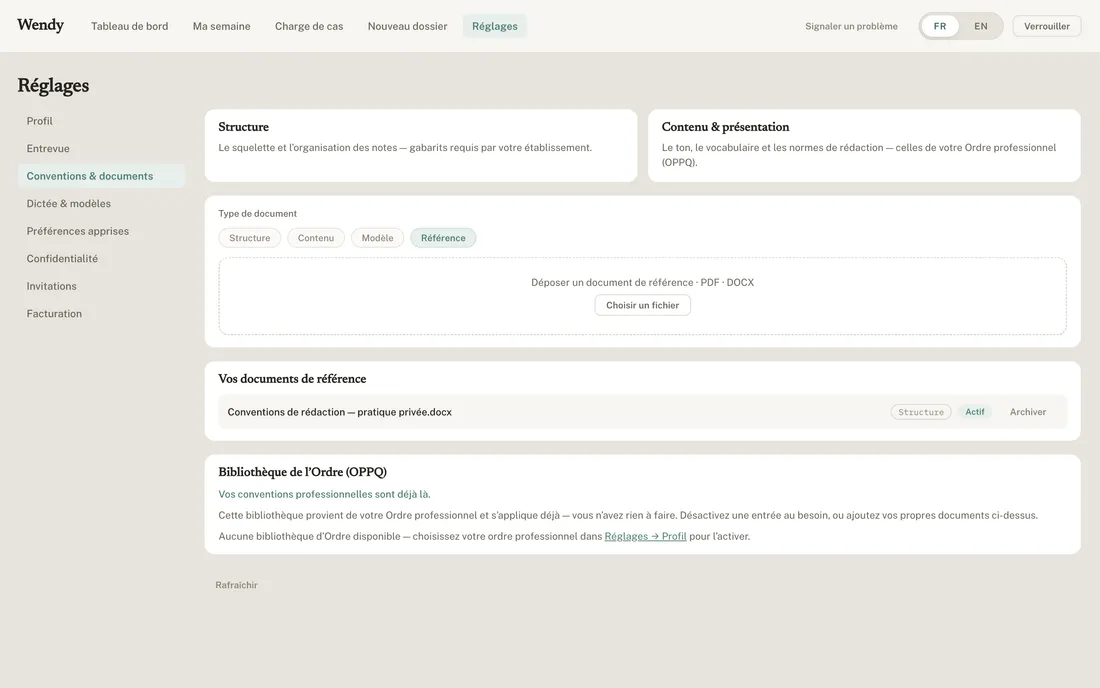
A view built for the person managing a whole team.
The same organization that simplifies a psychoeducator's day gives a director an overview of a caseload at the scale of an entire team.
Cabinet administration already exists in the product — self-serve purchase does not, yet.
Per-seat licensing administration, an admin dashboard, and referral mechanics exist in Wendy Doodat today. What's not yet open is a way to buy it self-serve, without a conversation first. So we start with a conversation — to understand your organization and show you exactly what's ready today.
Questions directors ask us
Are AI-generated notes legally defensible?
The AI drafts a note; the clinician reviews it, corrects it, and signs it before it becomes final. Every action — create, read, sign, rectify, export — writes a row to a permanent audit trail. Consent to AI use is dated, explicit, and revocable in the product today; revoking it blocks AI generation (dictation still works, in manual mode).
Will my psychoeducators actually trust the AI, or will they spend more time editing than writing?
We don't yet have customer data on correction time — the proof surface is honestly empty on this point right now. What we can show you: a mechanism designed to reduce correction over time. Every correction a practitioner makes is remembered and applied to future drafts — the draft gets closer to their own writing, correction by correction. That's a question worth exploring with your team in a demo, not a statistic we're selling you today.
French is non-negotiable for us — what's actually true here?
Voice dictation happens in French, not just the interface — the interface, help content, and templates are French too. The vocabulary is Quebec psychoeducation practice's own. We don't claim any Bill 96 certification (that would be inaccurate); French is the product's language of control, not a translation bolted on afterward.
Where is data hosted, and what about privacy?
Primary clinical records are hosted on Canadian soil (Toronto), as of a dated cutover. Client identities are encrypted on the device before anything leaves the workstation — built and tested so the server never receives a plaintext name, and that protection extends to internal admin tooling too. What's not yet true: backups aren't repointed to Canada yet, and voice transcription transits a US-hosted provider. Formal privacy certification is documented, substantial work — not yet obtained. We'll show you exactly where it stands rather than asserting it.
We already have an electronic health record — is this yet another system to learn?
Wendy Doodat isn't an EHR and isn't trying to replace one. PDF export is always available, with no forced double-entry. Deeper integrations with existing systems are a question we hear — we don't have an integration to point to yet.
What does this cost, in a budget-frozen environment?
The organizational (Cabinet) track exists in the product with per-seat administration, but self-serve purchase isn't open yet — so there's no public price sheet on the organization side right now. A conversation with your team lets us scope real numbers for your context, rather than start from a generic assumption.
See Wendy Doodat with your team.
A conversation, not a pitch. Show us your context — we'll show you exactly what's ready today, and what isn't yet.